
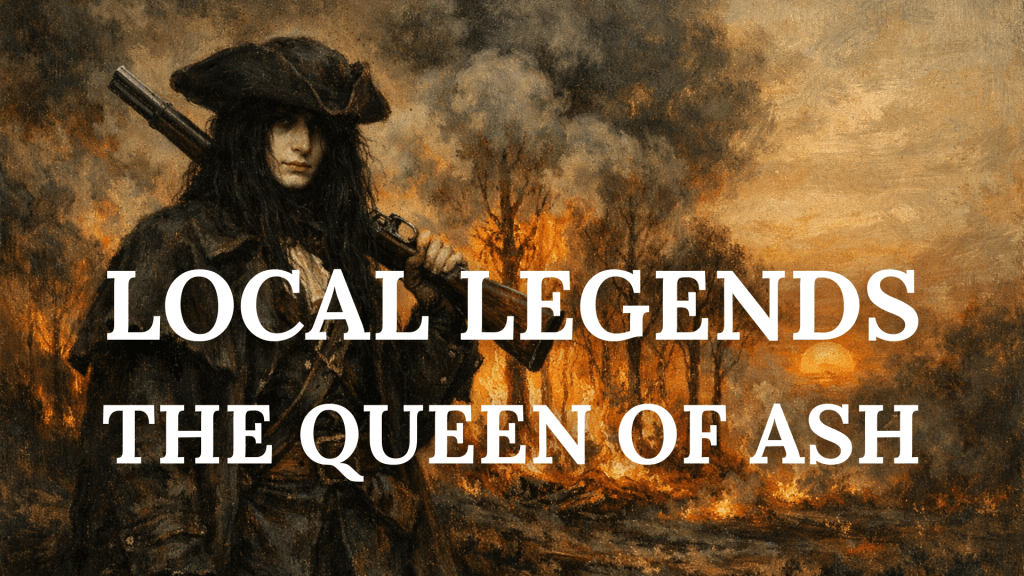
Some residents of Emerson Valley might be familiar with the name Brenna Morgan, but most have at least heard the title by which she is better known: The Queen of Ash. She is connected to a dark period in our town’s history, and her actions have echoed across time in ways many never anticipated. The legend of the Queen of Ash is controversial due to two very different interpretations of the events surrounding her infamous deeds.
In my research with the Emerson Valley Historical Society, I was able to find a number of facts that remain consistent across all versions of the story. Brenna was born in the summer of 1802 in a cottage built along the edge of the Overlook beside a dense grove of ash trees. Her father was a fur trapper who spent long stretches of time away from home, and her mother was a weaver who used cotton and flax to make cloth and linen for local merchants.
Brenna was known as an unruly child with wild black hair who spent her days roaming Blackwood Forest. She was taught to shoot at an early age, and often carried her father’s old hunting rifle with her on her excursions through the forest. Despite never receiving a formal education, she was highly intelligent, teaching herself to read and write using her family Bible, and had an inquisitive nature. If she were alive today, there’s no doubt those traits she would’ve allowed her to thrive. Unfortunately, being a rural woman in the early 19th century, they made her an outcast from society.
In 1818, Brenna’s father arranged for her to marry Colonel Neville Harrison, descendant of the infamous serial murderer James Harrison. He was a successful businessman and military commander who saw action during the Chesapeake campaign of the War of 1812, but his family history made him an unfavorable match among the town’s wealthy elite. Brenna herself opposed the match on similar grounds, but ultimately had no say in the matter. Rather than resign herself to a life of marital woes, she absconded with a sack of her mother’s woven cloth and her father’s old hunting rifle.
When Brenna ran away from her impending nuptials, Neville forced her father to hand over the deed to the family’s cottage as recompense. Her mother objected to being turned out of her own home, and an altercation occurred that resulted in both of her parents being slain by Neville’s men. He conducted a manhunt for Brenna, intending to force her to the altar, but they failed to find her. As a final insult to her family, he converted the cottage into brothel and named it “Brenna’s Dowry.”
At some point after fleeing Emerson Valley, Brenna fell in with a gang of brigands led by the notorious masked highwayman known as Silent Jack. Her specific role in the gang is unknown, but she was often spotted in the company of Silent Jack’s minions following a successful robbery. There were rumors that Brenna was Silent Jack’s lover, although she was never present during his daring stagecoach heists.
Because Silent Jack wore a mask and never spoke, some people believed he masqueraded as one of his own gang members when he wanted to go out in public. It was said that he never spoke because he’d had his tongue cut out in his youth as punishment for insulting the wife of an influential land baron, but there was no evidence of any such incident occurring in the state during that period.
By 1825, Neville had expanded Brenna’s Dowry into a booming operation and built several larger houses around the original cottage to accommodate the growing demand for his brothel’s services. He also built homes for his men nearby, creating a camp of prostitutes and former soldiers. To keep an eye on his sordid empire, he constructed a manor house for himself, and he managed to convince a local merchant to offer him the hand of his youngest daughter in marriage.
Brenna heard the news of Neville’s upcoming marriage to the 16-year-old girl and resolved to save her from the same fate she herself escaped. She recruited a surprising number of Silent Jack’s gang to aid her in her endeavor, although the highwayman himself failed to join her. They armed themselves and rode through the night, arriving on the outskirts of Emerson Valley three days before the wedding was to take place.
In the early hours of June 21, 1825, Neville awoke to the smell of burning wood. He rushed to his bedroom window and found the grove of ash trees had been set ablaze. The fire quickly spread to his brothel houses, and as he ordered his men to draw water from the well to put it out, a volley of gunfire rang out. Neville’s men dropped like flies as shots from the nearby hills continued to prevent anyone from dousing the blaze.
Prior to the attack, Brenna and the gang members had pulled the prostitutes from the brothels and brought them to a nook behind the hills where they were safely hidden away. Several of them reported that Brenna not only appeared at ease when leading the assault, but she was a shockingly-skilled marksman. She ordered the gang to avoid shooting Neville, and once he stood alone among the bloodied corpses of his men, she emerged to confront him.
Nobody knows what words were exchanged between the two, but Neville was visibly shaken by whatever Brenna said to him. He appeared to be pleading for his life, although his efforts were in vain. Brenna shot him with a pistol at point-blank range, and then set fire to his body. She then called for her gang to loot the manor house before setting it alight as well. The money and valuables collected were divided between the gang members and the prostitutes, and when they departed, Brenna remained behind to watch as everything burned to ashes.
The people of Emerson Valley saw thick plumes of smoke billowing from the Overlook, and a party was formed to investigate. By the time they arrived, there was nothing left of the camp but ruins. The ash trees were reduced to cinders and would never again grow in Emerson Valley. The party found no trace of Brenna, but she had left behind the diamond wedding ring intended for Neville’s bride, and it was wrapped in a mask made from the cloth woven by her mother.
Word of what happened at the Overlook spread as quickly as the flames across the grove. Several of the prostitutes were found and questioned, and they were the ones who revealed that Brenna led the attack on Neville and his men. The townsfolk began calling her the Queen of Ash—a reference to both the grove of ash trees and the ashes left behind from the blaze. Some people viewed her as a villain, while others saw her as a hero.
The young girl who was spared from marrying Neville refused to hear a bad word said against Brenna. She later recorded her preferred version of the tale which is still held by the Historical Society. The Sainted Queen of Ash by Penelope Brandt served as an invaluable source of information for this article. Sadly, I was unable to find anything concerning Brenna’s fate following the attack on Neville’s camp.
Mrs. Brandt’s story ended with Brenna walking into the burning ash tree grove and releasing her soul as it ascends to Heaven. However, in several letters written by the author and preserved by the Historical Society, she admits that her ending was merely a tragically romantic coda she invented so her book would have a definitive conclusion.
While Brenna seemed to disappear from history following her bloody coronation as the Queen of Ash, I found multiple references to Silent Jack’s activities from the late-1820s to the mid-1840s. When his gang returned from aiding Brenna get her revenge on Neville, they continued to rob wealthy travelers across the state. The highwayman and his gang earned a reputation as a sort of latter-day “Robin Hood and His Merrie Men.” The money they stole always seemed to find its way into the hands of those in need.
The last recorded instance of a Silent Jack sighting came on June 21, 1845—twenty years to the day after the burning of the ash trees and the brothel camp. He had been shot in the stomach by guards hired to protect a shipment of valuables headed for Richmond. Silent Jack managed to escape into the nearby forest, and all that was ever found was his mask. It was torn and covered in bloody fingerprints, and left hanging on the branch of an ash tree.
I believe that Brenna Morgan was Silent Jack. I have no solid proof of this notion, but I feel there is enough circumstantial evidence to connect the dots. If that turns out to be the case, then it’s safe to say that Brenna lived two more decades before meeting her end. She would have still died relatively young, but I like the idea that the Queen of Ash was both an avenger and a folk hero.
There are plenty of people who denounce her as a criminal and cold-blooded murderer, and those labels also ring true. Brenna was a complicated human being who wished to live free—a desire shared by the men who founded this country. While they were lauded for fighting back against their oppressors, Brenna was demonized for doing the same. She risked her life to save Mrs. Brandt from being forced to marry a wicked man, and if she was indeed Silent Jack, spread the wealth she stole among those whose needs society ignored.
Personally, I admire Brenna for refusing to bow to the whims of others. She was certainly rough around the edges and hardened by circumstance, but she also loved nature and followed a personal code that compelled her to fight back against the people who believed that money and power entitled them to take whatever they wanted without suffering any consequences. For Neville Harrison, Brenna Morgan became those consequences. That lesson was seared into the earth by the fiery crown of the Queen of Ash.
-Sarah Donovan, Local Legends, Emerson Valley Gazette






 Emerson Valley Gazette
Leave a comment