
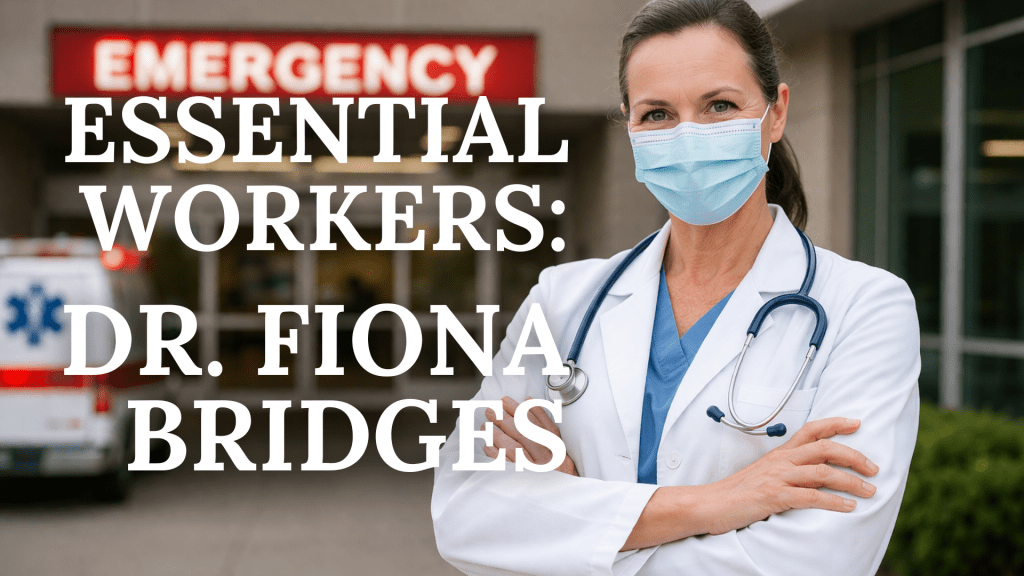
While most of Emerson Valley has been able to work from home due to the lockdown, those deemed “essential workers” don’t have that luxury. Medical personnel like Dr. Fiona Bridges are among those who have to show up at their job and risk infection for the sake of everyone else. As the head of the Medical Emergencies department at St. Benedict’s Hospital, she is the tip of the spear in the fight against COVID-19. I got the chance to speak with Dr. Bridges (from the safety of my own living room) about what it’s like out there on the front lines.
Emerson Valley Gazette: I know your free time is very limited, so I appreciate you talking to me today.
Dr. Fiona Bridges: I appreciate you giving me the opportunity to show people how dangerous COVID really is. There’s been a lot of murmuring about the lockdown being an overreaction to what’s essentially a “bad cold,” which is an incredibly reductive stance to take on a matter most people know precious little about.
Gazette: What makes COVID different from other viruses like it?
Bridges: Well, for starters, it has a whole host of symptoms that range from mildly irritating to severe and often fatal. In particular, it attacks the respiratory system, which can lead to serious complications and death indirectly if other medical issues are already present in a patient. The other big problem with COVID-19 is the rate of transmission and how easily it spreads. This leads to unanticipated permutations that makes it even harder to treat.
Gazette: How are you and your staff protecting yourself against such an infectious disease?
Bridges: By being incredibly careful with everything we do. We wear masks at all times, and gloves and face shields when dealing with patients; we keep a buffer between us and them unless it’s absolutely necessary to touch them; and we wash our hands and use hand sanitizer all throughout the day. We can’t completely protect ourselves, but we do our best to minimize the risk of infection. If any of us get infected, that’s one more patient and one less doctor or nurse to help with a medical community that’s already taxed to its limit.
Gazette: That’s a serious problem in the middle of a pandemic. But you aren’t only treating patients with COVID. It must be just as stressful when trying to treat patients that come in for other reasons.
Bridges: Precisely. The influx of COVID-19 patients have caused a problem with space and manpower for our other patients. If someone has a heart attack and the paramedics are too busy, or the ER is already full, the chances of that person surviving drops significantly. And that’s not even taking into account that sick people have immune systems that are already compromised, so exposure to COVID-19 puts them at even greater risk.
Gazette: It’s a wonder you’re not completely burnt out already.
Bridges: Oh, we’re definitely feeling burnt out already. But what can we do? It’s our job to take care of these patients. We can’t afford to take time off to recover mentally. I’ve got about three hours before I have to be back at my post, so I’m resting in my office. I don’t think I’ve been home in three or four days now. I know my family misses me, but they understand why I have to be here.
Gazette: In that case, I won’t take up any more of your time. Is there anything you want our readers to know about staying safe during the pandemic?
Bridges: Outside of what I mentioned we’re doing—masking, washing hands, social distancing—we’ve found that certain types of fungi have actually greatly reduced the chances of infection. The mushrooms that grow right around here in Blackwood Forest are rich in B vitamins like riboflavin, niacin, and copper, as well as Vitamin D, phosphorus, potassium, and zinc.
Gazette: I’ll have to keep that in mind. Thank you for giving our readers a bit of insight into what it’s like for you on the front lines of the pandemic.
Bridges: My pleasure. Hopefully the next time we talk, it’ll be under better circumstances.
I would like to remind everyone at home to stay vigilant and stay safe. The more people who can prevent themselves from catching COVID, the less extra work it’ll make for our medical professionals. And thank you again to all the essential workers who are putting their necks on the line to keep us safe.
-William Cooper, Human Interest, Emerson Valley Gazette




 Emerson Valley Gazette
Leave a comment