
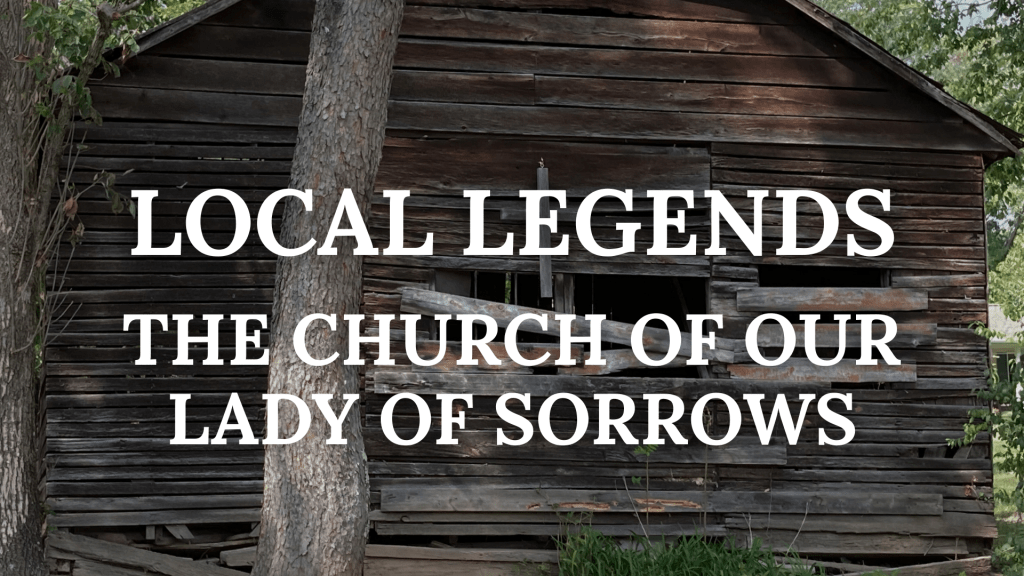
The Church of Our Lady of Sorrows is one of Emerson Valley’s oldest buildings, having been constructed when the first settlers arrived here in 1683. Technically, the original structure burned down in 1798, although the eastern wall and the foundation remained intact. It was rebuilt a year later, and that is what still stands in our town. Sadly, the church has long since been out of use and fallen into disrepair.
Despite no longer being utilized for its original function, the church remains an amazing place to visit. You can feel the history emanating from within, as if the ghosts of those that came before still linger beneath its broken roof, filling the rotted wooden pews and kneeling in prayer before a missing effigy of Christ. You can almost see the shadows of these people if you get close enough to peer in through the cracked boards that make up its walls.
Unfortunately, the Church of Our Lady of Sorrows is aptly named. There is a long history of unfortunate tragedies that befell those who were numbered among their congregation. Even before the aforementioned fire, stories were whispered between suspicious townsfolk of the dark deeds and sacrilegious rituals being performed within the church late at night. Most of their mistrust was centered around one man: Father Karl Bromstad.
Father Karl was a polarizing figure within the community. His parents had come to Emerson Valley in 1712, having moved here from the northeast. He was born in 1745, and spent his entire life here. When he became the head priest of the church in 1780, it was after his predecessor had died under mysterious circumstances. At first, nobody believed Father Karl had anything to do with the old priest’s death, but as the years went by, the rumors swirling about him brought the same question to people’s lips: Did Father Karl murder the man?
The accounts of what actually occurred on the night of July 4th, 1798 are hazy at best. Many people were in the town square celebrating. They had not been able to procure any fireworks, but there was still plenty of raucous gunfire and drunken cavorting amongst the youth, much to the disapproval of the older townsfolk. Father Karl was nowhere to be seen, despite his usual visibility on such occasions. By this time, his reputation had begun to sour with the public, so they didn’t see any reason to go fetch him.
At some point, late during the night, a group of young men made their way to the church. Their purpose for going there is unknown, but they had with them some firearms and and a piece of iron and flint. According to local newspapers in 1798, the men later claimed that when they arrived at the church, they heard Father Karl’s voice coming from inside. Curious about who he was speaking to at such a late hour, they went to check on him.
When they stepped into the church, they said that they found Father Karl in a dark, hooded robe, and he had set up a horrifying altar in front of the normal effigy that stood at the back of the building. According to them, it was made of human bones, and there seemed to be blood smeared in strange patterns on the floor. When the priest realized they were there, he lunged at them with a ritualistic dagger he’d been using to cut into a dead bird that was still writhing in pain within a wooden bowl at the center of the bloody symbols on the ground.
The men fired on Father Karl in self-defense, sending him reeling backwards. However, he rose to his feet once more, moving as if the pellets they’d shot him up with had no lasting effect. They fired again, and this time, one of the men grabbed the dagger that had fallen from Father Karl’s grip and stabbed him through the heart with it. This, it appears, finally put him down for good.
The abhorrent nature of the ceremony the priest had been performing disgusted the men so much, they felt that the only way to cleanse the church of such evil was to burn it down. They lit some of the more flammable ornamentation on fire, and did the same to Father Karl’s robe. Afterwards, the men fled the scene, only recounting this tale to the Gazette years later.
By the time the townsfolk were able to put out the blaze, most of the church was gone. There were no reports at the time of any sort of bone altar or other such dark accoutrements being recovered from the scene. The only thing they found besides the remains of the church’s normal decorations was the charred body of Father Karl. Despite the rumors, the people were still saddened by his death, and there was a fairly large turnout for his funeral.
It’s impossible to say for sure what really happened on that dreadful night in 1798. As the men who eventually claimed responsibility for the act only did so when they were much older, most with one foot in the grave, we can’t know whether they really did find the priest engaged in some arcane ritual, or if they had simply murdered Father Karl, burned down the church to cover up their crime, and then “confessed” to a version of the truth in order to clear their souls before meeting their maker. I could believe either is true, to be honest.
Regardless of this unfortunate event in the Church of Our Lady of Sorrows’ history, it is still a wonderful place to visit. There aren’t many other colonial-era structures left in Emerson Valley, so if you have a mind to see it, I suggest you do so sooner rather than later. You never know when some natural disaster, or just good, old-fashioned age might cause it to come toppling down, losing that link to our past forever. For myself, I’ve visited the place quite often, and I always find solace in knowing that while I’m there, I’m not alone.
-Sarah Donovan, Local Legends, Emerson Valley Gazette






 Emerson Valley Gazette
Leave a comment