
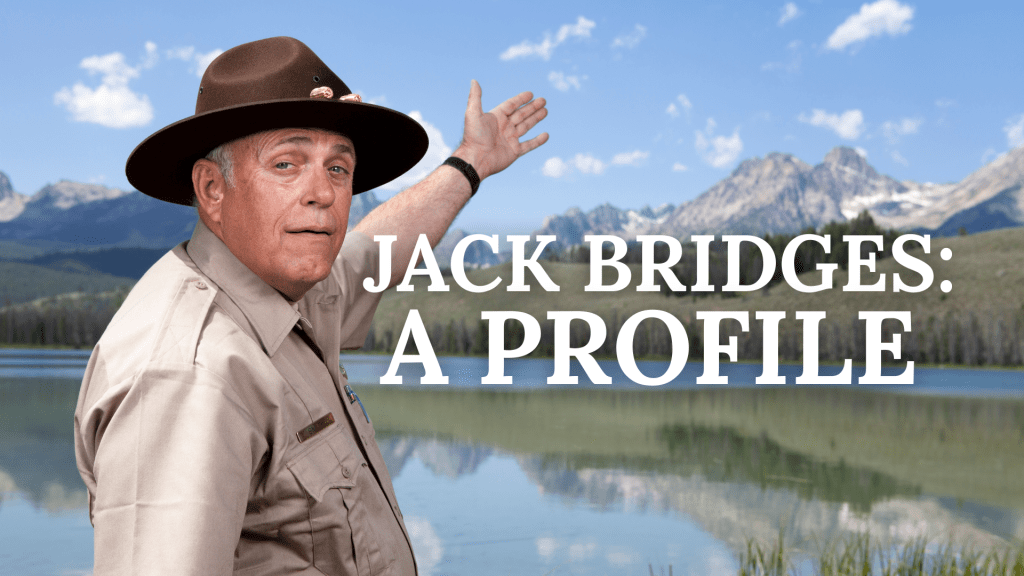
At the end of this year, Emerson Valley Park Ranger Jack Bridges will be retiring after 35 years of service. Trips to Blackwood Forest will be a little less colorful without his energetic tours and unrivaled knowledge of the trails. I remember the first time I met him shortly after joining the Gazette. He rattled off about a dozen different types of poisonous plants and fungi I needed to avoid. Luckily, I’m not much of an outdoorsman, so the fact that I can’t remember his warnings hasn’t worked against me.
Mr. Bridges is 58 years old and built like a linebacker. He actually played football in high school, and after graduating, went over to Vietnam with the US Army. When he returned from war, he was able to translate his experiences in the jungles overseas to the forests back home. He was offered a job by Shenandoah National Park and the Emerson Valley Park Service. Liking the idea of working in the woods where he grew up, Mr. Bridges chose the latter.
I got the opportunity to interview Mr. Bridges this week. We met at the Ranger Station, which has practically been his home for over three decades. It was a pleasant afternoon for a stroll through the woods. Mr. Bridges insisted we hike down the “C” trail, since it followed the river. According to him, as long as you can see the river, you’ll never get lost in the forest.
Emerson Valley Gazette: Let me get straight to the point—what made you decide to retire?
Jack Bridges: It wasn’t just one thing. There’s a whole collection of things that built up over time. I can feel the ache in my bones. They’re telling me I can’t do this much longer.
Gazette: I understand you’ve recently had someone disappear in the forest. Is the fact that he’s still missing affected your decision?
Bridges: Not him specifically. But Mr. Hollister isn’t the first person to go missing in these woods. I’ve always done my best to aid the police in their searches, but it’s rare to find someone once they’ve been gone for more than 24 hours. Unfortunately, I don’t think we’ll be seeing Mr. Hollister again. It’s a damn shame. I really feel for his wife.
Gazette: Why is it so hard to find these people when they go missing? Blackwood Forest is relatively small compared to other nature preserves in the state.
Bridges: I wish I knew. There’s something about this forest that goes beyond square acreage. It might not be as large as other forests, but it can be as vast as the world itself if you get lost. With everything I’ve seen during my time here, I know there’s something else at play.
Gazette: What exactly do you mean by that?
Bridges: These woods have been here longer than the town. Longer than people have been around. They might even go back to before the dinosaurs. Do you really think that in all that time, the only things to live here were us and the animals?
Gazette: I…I really don’t know. I’ve never thought about it before.
Bridges: You hear voices sometimes. Strange, ethereal voices. They’re not quite right. At first, they seem human enough, but when you get closer, you realize it’s just mimicry. It’s like a worm on a fish hook. It’s bait.
Gazette: Bait for what? For us?
Bridges: For anyone foolish enough to wander into the forest alone.
Gazette: Have you ever heard the voices yourself?
Bridges: Of course. I’ve spent a lot of time alone in the woods. But I’ve walked these trails since I was a boy. I know them like the back of my hand. And I know that when I hear the voices, I need to run away from them as fast as I can. I’ve gotten old, though. I can’t move as fast as I used to. It’s part of why I decided it was time to retire.
Gazette: But who’s voices are they?
Bridges: (Shaking his head) I don’t know, and I don’t want to know. If you were to ever find out, I don’t think you’d come back. At least not as yourself.
Gazette: That sounds really ominous, Jack. If you don’t come back as yourself, who do you come back as?
Bridges: I can’t say for sure, but…there was a ranger who used to work here. Brett Andrews. This was back in the eighties. I was still pretty new to the park service. Brett started in the summer of the same year the Mets won the World Series. I remember that because he was a huge fan, and he listened to that final game on the radio in the Ranger Station.
Gazette: That would’ve been in ’86. Bill Buckner made his famous blunder in Game 6 to let certain victory slip through the Red Sox’ fingers. Then the Mets won in Game 7 to take the series.
Bridges: (Chuckles) I had you pegged as a sports guy. Why’re you out here doing a story on me instead of a game somewhere?
Gazette: The Gazette doesn’t have a sports reporter. Back when we still had an actual newspaper, our sports section was mostly articles about college and the pros from the AP or nationally-syndicated columns. Now that we’re online, there’s no point in that. If something significant happens, our Activities guy handles it.
Bridges: Oh, okay. Gotcha. Wait—what were we talking about?
Gazette: You were telling me about Brett Andrews.
Bridges: Right, right. Brett was one of those guys who lived or died by how macho he seemed. He was always talking about the different ways he’d take down a bear if he had to, or how many women he’d bedded. It got old fast, but he was a decent guy. He was fast, too. If you called in a problem on the trails, he was the first on the scene.
Gazette: So what happened to him?
Bridges: Some campers came into the station one night in late November and reported that their friend had gone missing. They took Me and Brett down to the site where they’d been camping, and pointed out which direction they last saw their friend go. At this point, it had to be past midnight, and it was freezing. I told Brett we’d go back to the station and wait till morning, then come back for a proper search with more help. But that wasn’t Brett’s style. Waiting for help was for cowards, he said. I tried to get him to see reason, but he was determined to keep looking. I didn’t have any other choice but to go back without him. I didn’t want to get lost and freeze to death out there.
Gazette: Of course. Not much more you could’ve done if he refused to listen.
Bridges: Well, as you can guess, he didn’t report in. As soon as it was morning, I grabbed a couple other rangers, and we went back to the campsite. It only took us about an hour to find the missing camper. The group had been drinking, and he went off to find somewhere to pee and got lost. He hunkered down under some big rocks to keep out of the wind and passed out. When we found him, he was barely alive. We tried to get him to the hospital, but St. Benedict’s hadn’t been built yet. The closest place was an hour away. He…he didn’t make it.
Gazette: I’m sorry. That must’ve been hard.
Bridges: Yeah, it’s never easy when someone dies on your watch. Poor kid died of hypothermia.
Gazette: Did you ever find Brett?
Bridges: Didn’t have to. He checked in at the Ranger Station a week later. It was so strange. He came in saying he looked for the missing camper all night but couldn’t find him. When we told him that he’d been missing for a week, it didn’t seem to faze him. Old Andy Filmore who was in charge at the time really laid into him. I thought for sure they’d end up in a fistfight, but Brett just sort of shrugged it off.
Gazette: And he had no memory of where he’d been for the entire week?
Bridges: No. We were working on cleaning up some of the trails one afternoon the following spring, and some kids were having a picnic with their family. They were singing, and Brett got this glazed look in his eyes. He asked me if I heard the voices the night we went out to that campsite. I told him no, and he said they were the most beautiful voices he’d ever heard. Then out of nowhere, he grabbed me by my collar and got right in my face, screaming that the voices were a lie. I pushed him off me and got ready to fight him, but he stood up and acted like none of it happened.
Gazette: What made him leave the park service?
Bridges: I don’t know. One day, he just didn’t show up for work. We tried calling—even sent someone around to his apartment—but he was just gone. Completely vanished. I never saw him again. Hell, I never heard about him again. I have no idea if he’s even still alive. But after that week in the forest, he was never the same. And I know he’s not the only person that’s happened to.
Gazette: The wilderness is a dangerous place. Lots of things can happen to you if you’re not careful. But I have to imagine it’s been safer in your care over the last 35 years.
Bridges: Ah, who knows. I hope that’s true, but I’ve got way too many memories of failing to save people out here. They always tell you that you can’t save everyone, but that’s not much comfort. People’s deaths aren’t something you can just shrug off. They cling to you like a bad odor. No matter how hard you scrub, the stench is always there.
Gazette: I can see those losses really affected you.
Bridges: Yeah, sorry about that. I’ve gotten very reflective in my old age. You can’t help but wonder if you could’ve done things different.
Gazette: If you could go back, what would you do differently?
Bridges: I’d take that job at Shenandoah instead. Ah, don’t listen to me. I’d probably be saying the same thing if I’d gone to work there rather than come here. I really did enjoy being a ranger in Blackwood. Most of the time, it was really rewarding. There’s just been so many problems recently, the bad is overshadowing the good in my mind.
Gazette: What kind of problems have you been having?
Bridges: The kind I’d rather forget about. It’s getting late. We should head back. There’s a chill on the wind, and that always spells trouble out here. We’ll swing by the station again, and you can sample the swill they’ve been passing off as coffee since Nixon was in office.
I’d like to thank Mr. Bridges for serving our town faithfully for 35 years. It’s an extraordinary achievement. I know everyone will join me in wishing our dear ranger well in whatever the future might bring. You certainly deserve to rest now, Mr. Bridges, so rest easy.
-William Cooper, Human Interest, Emerson Valley Gazette





 Emerson Valley Gazette
Leave a comment