
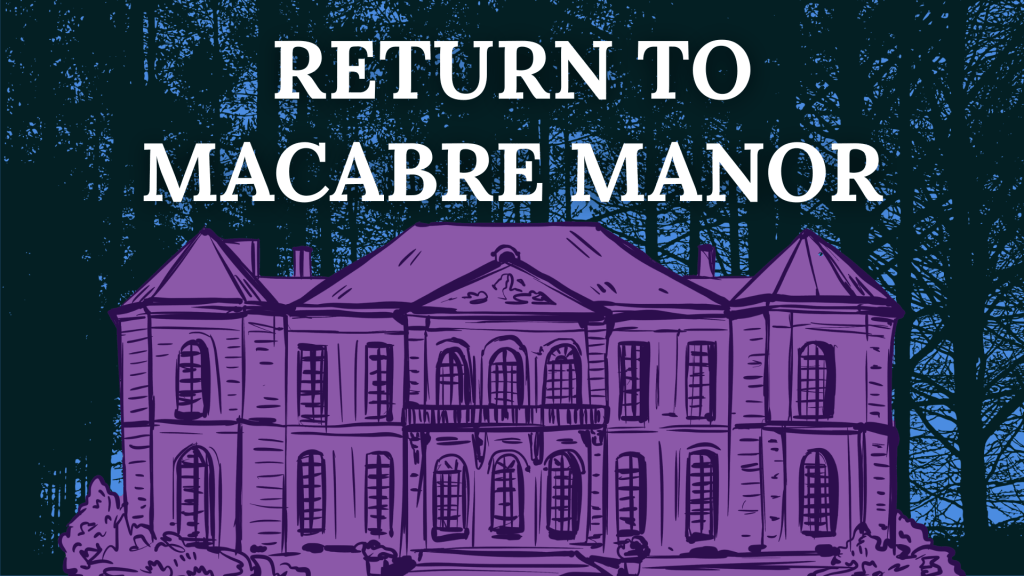
In 1952, Emerson Valley native and horror/mystery author Milton Philip Hanover, better known as M.P. Hanover, released the first of what would become his career-defining series: Tales from Macabre Manor. While the series never reached the heights of other youth-oriented titles like The Chronicles of Narnia, The Hardy Boys, Nancy Drew, or Beverly Cleary’s Ramona series, Tales from Macabre Manor saw a fair bit of regional success in the 1950s and early 1960s.
Hanover abruptly stopped publishing his series after the 1964’s The Yellow Door. He never offered a reason for his decision to stop writing, and he secluded himself in his home beneath the shadow of the Rookery as his books were forgotten by the next wave of popular children’s literature. Hanover was killed in 1970 when confronting an armed intruder who had broken into his home in search of valuables to steal. A neighbor reported hearing gunshots around 3 AM, and by the time the police arrived, his house had been ransacked and he was dead.
Although Hanover’s legacy as an author was largely ignored by the literary community, those who grew up reading his books have fond memories of the series. In 1999, the Carson Hills Journal included him as one of their top 20 mid-century children and young adult authors, coming in at number 13. His entry described his books as “hauntingly beautiful gothic tales of mystery and horror,” and singled out 1958’s The Empty Grave as the author at his finest.
Hanover wrote a total of seven books in the Tales from Macabre Manor series, starting with The Flowers of Pine Valley in 1952. This first installment introduced many of the elements that went on to become staples of the series, including the main setting of Pine Valley. It’s not hard to see that Hanover’s fictional town was heavily based on Emerson Valley.
Many of the landmarks described in the book are easily recognizable as locations present in our town at the time. The titular Macabre Manor, known within the stories themselves as Mallory Manor, was a thinly-veiled rendition of the Rookery. The Mallory family also shares many similarities to the Rooks, such as the owner of the manor being a widower with a 12-year-old boy.
During the period that Hanover composed The Flowers of Pine Valley, Jacob Rook was raising his son Thomas at the Rookery. Jacob’s wife Enid was murdered in 1947, and the police never managed to solve the case. In the book, Maxwell Mallory had a son named Milton, and there’s a few mentions of Maxwell’s late wife Ingrid. At one point, Maxwell tells another character that it had been five years since Ingrid was “taken from us.” Unlike her real-life inspiration, solving Ingrid’s murder eventually became an important plot point in the series.
Central to The Flowers of Pine Valley is Brokenwood Forest, where a special breed of orchid known as the black-stem orchid grows wild. The novel follows young Milton Mallory as he stumbles upon a book in the manor’s library called Pine Valley Fables. Pressed between the pages is a black-stem orchid, which seems to mark a fable titled “The Dancing Wraith.” Milton embarks on a journey to learn more about the Dancing Wraith, who the people of Pine Valley both know and fear, steadfastly refusing to answer any of Milton’s questions.
Unable to get any answers from the townspeople, Milton decides to reenact the fable in order to see the Dancing Wraith for himself. He ventures into Brokenwood Forest alone at night under a full moon and follows the directions from the story, which lead him to a glade filled with black-stem orchids. In the fable, a boy picks one of the orchids, which triggers the wrath of the Dancing Wraith. Milton departs from the fable here, burying the pressed orchid instead of taking one.
As the boy suspected, this action summons the Dancing Wraith not in anger, but in gratitude. She confirms that the boy from the fable was, in fact, Milton’s great-great-grandfather, Malachi Mallory. After stealing the orchid from the her glade, Malachi cursed the family for generations. However, Milton’s actions breaks the curse, freeing him from assuredly suffering like the previous generations of the Mallory family.
It’s interesting to note that Hanover gave his young hero the same first name as himself. Much of the fictional Milton’s character was drawn from Hanover, such as his interest in history and mythology, a slight limp that was the result of a birth defect in his right leg, and the boy’s quiet, introspective nature. Because Milton was nearly a self-insert of the author, his life ends up being very different from that of Thomas Rook.
While Milton broke his family curse and went on to help other residents of Pine Valley with their own supernatural problems, growing up over the course of the series to find happiness with a wife and children, Thomas continued the Rook family tradition of enduring a life of great misfortune. There’s no evidence that Thomas was aware of the Tales from Macabre Manor series or its connection to his family, although it makes you how the conversation between Thomas and Hanover might have gone if he had.
-William Cooper & Elizabeth Barton, Human Interest, Emerson Valley Gazette







 Emerson Valley Gazette
Leave a comment